The disinfection of high - level bio-safety laboratories poses challenges in terms of personnel safety, disinfection efficacy, and corrosiveness to items. In this study, whole- room disinfection of BSL-3 using a dry mist H2O2 generator and a vaporized H2O2 generator, as well as dry mist disinfection of HEPA exhaust, were proposed. A dry-mist H2O2 generator and a vaporized H2O2generator were applied individually to disinfect the space of the BSL-3, along with BSC and HEPA unit. Spores of B.subtilisvar.niger and B.stearothermophiluswere applied as biological indicators to conduct a qualitative assessment of the disinfection efficacy. The dry- mist H2O2 generator, utilizing a 10% H2O2 solution at a dosage of 10 mL/m³ and with a disinfection duration of 3h, achieved a killing logarithm of 5- 6 log10 for the two types of spores. The identical efficacy was achieved for the vaporized H2O2 generator, by 35% H2O2 at a dosage of 6.5 mL/m³ and with a residual duration of 3h. The disinfection of the exhaust HEPA verification port using 10% dry-mist H2O2 presented significant challenges. All spores were capable of being inactivated when the port was uncovered; while the inactivation of all spores was not achieved when the port was covered. Dry mist H2O2 and vaporized H2O2 disinfection methods demonstrated stable spatial disinfection effect on B.subtilisvar.nigerand B.stearothermophilus. Achieving the disinfection effect at the disinfection verification port of the HEPA exhaust for the dry mist H2O2 disinfection poses a significant challenge.
This is an Open Access article, distributed under the terms of the Creative Commons Attribution 4.0 International License (http://creativecommons.org/licenses/by/4.0/), which permits unrestricted use, distribution and reproduction in any medium or format, provided the original work is properly cited.
The Biosafety Level-3 Laboratory (BSL-3) is specifically designed for the manipulation of pathogenic microorganisms, which are aerosol- borne transmission, and may lead to severe, even fatal diseases
[1]
Sahay R R, Patil D Y, Shete A M, et al. Rapidly deployable mobile BSL-3 laboratory: a response to the Nipah virus outbreak in Kozhikode, Kerala, India, 2023. Pathogens and global health, 2026, 120(1): 18-27.
, such as Mycobacterium tuberculosis, SARS coronavirus, and Bacillus anthracis
[2]
National Certificationan dAccreditation Standardization Technical Committee Laboratory. General Requirements for Biosafety, China Standards Press, Beijing, 2009 GB19489-2008.
[2]
. Effective disinfection measures are indispensable for safeguarding the experimental personnel and the environment
[3]
Yeh K B, Tabynov K, Parekh F K, et al. Significance of High-Containment Biological Laboratories Performing Work During the COVID-19 Pandemic: Biosafety Level-3 and -4 Labs. Frontiers in bioengineering and biotechnology, 2021, 9: 720315.
Disinfection involves the elimination or removal of pathogenic microorganisms and to interrupt the dissemination of microorganisms. The comprehensive terminal disinfection conducted in BSL-3 subsequent to experimental activities aims to eradicate the pathogenic microorganisms, and consequently preventing laboratory- associated infection and environmental contamination. It is indispensable upon the completion of work in high-level bio-safety laboratories. Surface and air are highly concerned in the terminal disinfection of BSL-3, and special attention should be paid to the high efficiency particulate air filter (HEPA) unit. In accordance with the laboratory standards of the World Health Organization (WHO) and China, all HEPA units in the exhaust system of the core area of a bio-safety laboratory must be conducted in-situ disinfection prior to monitoring or replacement
[2]
National Certificationan dAccreditation Standardization Technical Committee Laboratory. General Requirements for Biosafety, China Standards Press, Beijing, 2009 GB19489-2008.
[4]
Chinese Academy of Building Research Biosafety Laboratory Building Technical. Specification, China Building Industry Press, Beijing, 2012. GB50346-2011.
[2, 4]
. HEPA unit is an important secondary protective barrier in the exhaust system of bio-safety laboratory to prevent the leakage of polluted air, which can filter more than 99.97% of particles with diameter larger than 0.3μm in the laboratory
[5]
Christopherson D A, Yao W C, Lu M, et al. High-Efficiency Particulate Air Filters in the Era of COVID-19: Function and Efficacy. Otolaryngology--head and neck surgery: official journal of American Academy of Otolaryngology-Head and Neck Surgery, 2020, 163(6):
. Despite the high efficiency of HEPA unit used in bio-safety laboratories, laboratory-acquired infections still occur intermittently
[6]
Zuo K, Wu Z, Zhao C, et al. Risk and countermeasure of laboratory-acquired infection based on pathogen transmission routes. Biosafety and health, 2023, 5(3): 133-137.
. The microorganisms filtered by HEPA units are capable of reproducing under suitable temperature and humidity conditions. To guarantee the environmental safety, it is essential to perform in-situ disinfection of the HEPA unit
[7]
HanWendong, Zhiping S, Yuena D, et al. Study on In-situ Disinfection of Exhaust High Efficiency Air Filter in Core Area of Biosafety Level 3 Laboratory. Microorganisms and Infections, 2012, 7(03): 146-151.
[7]
.
The commonly employed whole-room disinfection in BSL-3 is chemical disinfection
[8]
Xin C, Xiaobin L, Hui W, et al. Verification and evaluation of disinfection effect of ventilation system in high-level biosafety laboratory. HV&AC, 2024, 54(05): 134-138.
, especially vaporized hydrogen peroxide (H2O2) and dry mist H2O2. The H2O2 is vaporized into small particles by the generator, which is particularly effective for microorganisms with strong resistance such as spores and viruses, and there is no residual toxicity as the decomposition products of H2O2 are water and O2. It is especially suitable for the disinfection of precision equipments such as incubators, centrifuge and biological safety cabinets (BSC). Vaporized H2O2 disinfection has been widely used in pharmaceutical
[9]
Ali D, S Peláez S, Lemazurier T, et al. Vaporized Hydogen Peroxide Uptake by Tubing used for Aseptic Fill-Finish Manufacturing of Biopharmaceutical Drug Products. European journal of pharmaceutics and biopharmaceutics: official journal of Arbeitsgemeinschaft fur Pharmazeutische Verfahrenstechnik e.V, 2025, 207: 114618.
Meleties M, Cooper B M, Marcano-James D, et al. Vaporized Hydrogen Peroxide Sterilization in the Production of Protein Therapeutics: Uptake and Effects on Product Quality. Journal of pharmaceutical sciences, 2023, 112(12): 2991-3004.
Zhao C, Qi L, Li L, et al. Using vaporized hydrogen peroxide for anhydrous disinfection of gastrointestinal endoscopes. World journal of gastroenterology, 2025, 31(14): 103921.
Kardas P, Bielec F, Brauncajs M, et al. Evaluation of disinfection methods for autonomous mobile robots used in hospital logistics in emergency departments. The Journal of hospital infection, 2025, 162: 17-25.
Meizhu W, Huiying S, Zhifang Y, et al. Observation on the effect of hydrogen peroxide dry mist disinfection equipment on terminal disinfection in intensive care unit. Chinese journal of disinfection, 2023, 40(03): 167-169.
[11-13]
, biosafety
[14]
Lieu A, Mah J, Zanichelli V, et al. Impact of extended use and decontamination with vaporized hydrogen peroxide on N95 respirator fit. American journal of infection control, 2020, 48(12): 1457-1461.
Cramer A K, Plana D, Yang H, et al. Analysis of SteraMist ionized hydrogen peroxide technology in the sterilization of N95 respirators and other PPE: a quality improvement study. medRxiv: the preprint server for health sciences, 2020: 2020-2024.
and other fields with high disinfection requirements. The difference between dry mist H2O2 and vaporized H2O2 is that the dry mist disinfectant is atomized into smaller dry particles
[16]
Cole M. Impact of dry hydrogen peroxide on environmental bioburden reduction in a long-term care facility. American journal of infection control, 2023, 51(12): 1344-1349.
. Dry particles experience Brownian motion in the air and remain suspended in the air for an extended period. They demonstrate excellent diffusivity, guaranteeing comprehensive coverage with no blind spots. Furthermore, they exert less corrosive effects on the equipment, color - steel sheets, and walls within the laboratory.
Numerous researchers have carried out studies on high-level bio-safety laboratories. Li Jinhua et al
[17]
Jinhua L, Ruijia L, Changrong S, et al. Disinfection effect verification of three-level biosafety laboratory and key protective equipment. Chinese journal of disinfection, 2024, 41(12): 889-892.
[17]
employed 8.2% H2O2 for sterilization in the BSL - 3, using B. stearothermophilus spores as biological indicators. The results indicated that all spore indicators were effectively inactivated. When 9% H2O2 was used, with disinfection durations of 3.5 h and 5 h, it could completely eradicate the Bacillus carriers in the space, inside the biological safety cabinet (BSC), and in the exhaust of the HEPA unit of the laboratory. Wang Zequan et al.
[18]
Zequan W, Linxia Y, Zhiqin X, et al. Effect evaluation of hydrogen peroxide disinfectant on terminal disinfection of ward. Chinese journal of nosocomial, 2025, 35(21): 3326-3329.
[18]
reported that the qualification ration of air disinfection in the ward of discharged patients by 7.5% H2O2 dry-mist generator was 96.00%, and B. stearothermophilus (ATCC 12980) with a spore content of more than 1×10⁶ CFU/piece could be entirely eradicated.
However, the in-situ disinfection of HEPA units remains a scarcely explored area. The disinfection are predominantly investigated by carrier qualitative disinfection tests
[19]
Jia H Q, Li Y J, Sun B, et al. Evaluation of vaporized hydrogen peroxide fumigation as a method for the bio-decontamination of the high efficiency particulate air filter unit. Biomedical and environmental sciences: BES, 2013, 26(2): 110-117.
Falaise C, Bouvattier C, Larigauderie G, et al. Hydrogen Peroxide Vapor Decontamination of Hazard Group 3 Bacteria and Viruses in a Biosafety Level 3 Laboratory. Applied biosafety, 2022, 27(1): 15-22.
. In our previous research, we have verified the efficacy of dry - mist H2O2 against bacteria and spores, and demonstrated its high disinfection efficiency. In this study, we compare the disinfection efficiency of dry-mist and vaporized H2O2 by qualitatively assessing the spores of Bacillus subtilis var. niger and Bacillus stearothermophilus in a BSL-3. Specifically, our objective is to observe the disinfection efficiency of the exhaust HEPA unit disinfection verification port through dry-mist disinfection.
2. Materials and Methods
Spores of Bacillus subtilis var. niger (B. subtilis var. niger; ATCC 9372), and Bacillus stearothermophilus (B. stearothermophilus; ATCC 7953) were used as bio-indicators and were qualitatively evaluated. They are commercially available product (Beijing Sihuan, China) in filter paper coupons containing 5 × 10⁵ to 5 × 10⁶ CFU/coupon. Dry mist H2O2 generator (NOCOSPRAY2, OXY-PHARM, France) and vapor H2O2 generator (HTY-SUPER SD5, Tailin, Zhejiang, China) were applied. H2O2 plasma sterilization chemical indicating cards (Xinhua, Shandong, China) were also used to chemically indicate the disinfection efficacy.
2.1. Preparation of the Disinfection
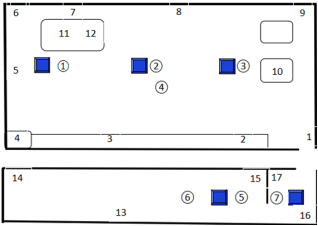
The validation test was carried out in a 91 m³ BSL - 3 core laboratory, along with a 65 m³ preparation room and buffer room. The bio-closure valve, negative pressure and ventilation systems of the BSL-3 were closed. Spores of B. subtilis var. Niger and B. stearothermophilus coupons were employed as indicators and aseptically affixed to the corresponding positions at varying heights, including the floor, table, and wall in the core room, preparation room, and buffer room, along with BSC and HEPA unit (Figure 1). The BSC were set to operating conditions with the front shields opened. Biological indicators were deposited on the countertop and at the exhaust HEPA of the BSC.
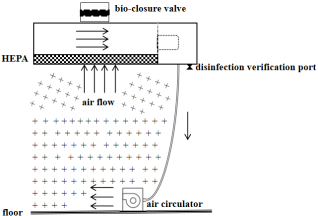
The disinfection valve was activated for the in-situ disinfection of the HEPA unit of the laboratory. Test coupons were deposited at the HEPA exhaust disinfection verification port. Air circulators were connected to the disinfection interface of the in- situ exhaust HEPA (Figure 2) according to the manufacturer.
Figure 2. Schematic presentation of in-situ disinfection verification of HEPA unit.
2.2. Disinfection and Detection
Whole-room disinfection within the laboratory was conducted using a dry - mist H2O2 generator and a vapor H2O2 generator, individually. The core room was disinfected independently, while the preparation room and the buffer room were disinfected as a group with the connected door opened. The laboratory was maintained at 20℃~26℃, 30%~65% R. H (relative humanity). Each test was replicated 3 times.
2.2.1. Dry Mist H2O2 Disinfection
A dry-mist H2O2 generator containing 10% H2O2 at a dosage of 10 mL/m³ was positioned in the middle of the laboratory. The device was activated, and the indicating volume was adjusted to the corresponding quantity of the disinfectant required, then the instrument initiated automatically 25s after emitting a beep. Once the program was completed, the program stopped automatically, and the disinfectant was left residual for 3h. Subsequently, the ventilation system of the laboratory was activated to conduct ventilation for 30 min to eliminate the residual disinfectant.
2.2.2. Vaporized H2O2 Disinfection
A vaporized H2O2 generator using 35% H2O2 at a dosage of 6.5 mL/m³ was employed. The program (comprising machine pre-heating, disinfection, and residual removal) was executed, and the residual was allowed to residual for 3h. Subsequently, the ventilation system of the laboratory was activated to conduct ventilation for 30 min to eliminate the residual disinfectant.
2.2.3. Cultivation of Spores
Personnel equipped with appropriate personal protective equipment entered the laboratory subsequent to disinfection and retrieved the spore coupons from each sampling point by aseptic operation. The coupons of B. subtilis var. niger were placed into a test tube with 5 mL of neutralizing solution (0.5% sodium thiosulfate + 0.5% Tween - 80) in nutrient broth and incubated at 37℃ for 3 days. Additionally, the B. stearothermophilus coupons were transferred into a 5 mL test tube of bromocresol purple peptone medium that contained neutralizing solution (0.5% sodium thiosulfate + 0.5% Tween - 80) and incubated at 56℃ for 7 days. Negative results from the spore cultivation indicated that the disinfection was qualified.
2.3.4. Observation of H2O2 Chemical Indicating Cards
The color change of the H2O2 sterilization chemical indicating cards was observed post- disinfection. Disinfection was considered to be qualified when the color of the indicating cards attained or surpassed the standard color.
3. Results
3.1. Space Disinfection
The disinfection carried out using dry-mist H2O2 generator with 10% H2O2 at a dosage of 10 mL/m³ and vaporized H2O2 with 35% at a dosage of 6.5 mL/m³, with both a residual time of 3h. The cultivation of B. subtilis var. niger and B. stearothermophilus spores on the floor, wall, BSC and transfer window were all negative, suggesting that the disinfection process can effectively eliminate 5 - 6 log10 of B. subtilis var. niger and B. stearothermophilus on the space (Table 1). Results indicated that spores at different heights were inactivated. Simultaneously, all the sterilization chemical indicating cards in the laboratory space were changed to standard colour.
Table 1. Disinfection efficacy of the space.
sample
Location and height
Dry mist
vaporized
B.subtilisvar.niger
B.stearothermophilus
B.subtilisvar.niger
B.stearothermophilus
1
behind the door (1.2m)
0/3
0/3
0/3
0/3
2
table (0.8m)
0/3
0/3
0/3
0/3
3
table (0.8m)
0/3
0/3
0/3
0/3
4
transfer window with door opened
0/3
0/3
0/3
0/3
5
floor
0/3
0/3
0/3
0/3
6
corner (1.5m)
0/3
0/3
0/3
0/3
7
back wall of BSC (1.5m)
0/3
0/3
0/3
0/3
8
corner (1.2m)
0/3
0/3
0/3
0/3
9
back of the incubator (1.2m)
0/3
0/3
0/3
0/3
10
Side wall of the refrigerator (1.2m)
0/3
0/3
0/3
0/3
11
inside of BSC
0/3
0/3
0/3
0/3
12
HEPA exhaust port of BSC
0/3
0/3
0/3
0/3
13
floor
0/3
0/3
0/3
0/3
14
wall (1.0m)
0/3
0/3
0/3
0/3
15
wall (1.5m)
0/3
0/3
0/3
0/3
16
floor
0/3
0/3
0/3
0/3
17
wall (1.2m)
0/3
0/3
0/3
0/3
Note: The denominator means 3 tests. The molecule is the number of unqualified tests for 3 tests.
3.2. In-situ Disinfection of the Exhaust HEPA Unit
In-situ disinfection of the exhaust HEPA unit was conducted using a dry- mist H2O2 generator with 10% H2O2 at a dosage of 10 mL/m³and a residual time of 3h. All spore tests at the outlet of the air circulators were negative, while the cultivation results at the disinfection verification port of the exhaust HEPA were dependent. Neither of the two types of spores was fully inactivated when the disinfection verification port was covered. Simultaneously, the indicating cards at the disinfection verification port of the HEPA units failed to meet the colour change. However, upon removing the lid, both spore types could be fully inactivated, achieving a killing logarithm of 5-6 log10 (Table 2). This finding suggested that it was difficult for H2O2 to penetrate the disinfection verification port of the HEPA unit when covered the port.
Table 2. Disinfection efficacy of the HEPA units.
Sample
Location
10%a
10%b
B. subtilis var. niger
B. stearothermophilus
chemical indicating cards
B. subtilis var. niger
B. stearothermophilus
chemical indicating cards
1.
HEPA exhaust disinfection verification port (left) in the core room
0/3
1/3
0/3
0/3
0/3
0/3
2.
HEPA exhaust disinfection verification port (middle) in the core room
1/3
1/3
1/3
0/3
0/3
0/3
3.
HEPA exhaust disinfection verification port (right) in the core room
1/3
1/3
1/3
0/3
0/3
0/3
4.
air outlet of gas blanketing circulator in the core room
0/3
0/3
0/3
0/3
0/3
0/3
5.
HEPA exhaust disinfection verification port in the preparation room
0/3
0/3
0/3
0/3
0/3
0/3
6.
outlet of air circulator in the preparation room
0/3
0/3
0/3
0/3
0/3
0/3
7.
HEPA exhaust disinfection verification port in the buffer room
0/3
0/3
0/3
0/3
0/3
0/3
Note: ‘a’ cover the verification lid, ‘b’ uncover the verification lid. The denominator means 3 tests. The molecule is the number of unqualified tests for 3 tests.
4. Discussion
Dry mist and vaporized H2O2 generators were employed to validate the disinfection of laboratory space and HEPA exhaust. The two disinfection methods demonstrated a killing logarithm of 5-6 log10 on spores of B. subtilis var. niger and B. stearothermophilus in the space. The killing efficacy of the dry mist H2O2 generator on the exhaust of HEPA unit is associated with the sealing status. The spores can be thoroughly inactivated when the verification port was not sealed, however, complete inactivation can not be achieved when it was sealed.
Under the condition of 10% H2O2 and a space dosage of 1.00 g/m³, the dry mist H2O2 generator can perform whole-room disinfection with 3h residual. There was no moisture observed on the object surfaces after disinfection, and the corrosion was minimal over an observation period of approximately 5 years. The vaporized H2O2 can also inactivate 5-6 log10 spores of B. subtilis var. niger and B. stearothermophilus under the conditions of 35% H2O2 and a space dosage of 2.23 g/m³. Upon inspection, it was noted that the surface of the object exhibited slight moisture subsequent to disinfection. Moreover, after several years of repeated use, foaming corrosion was observed on the colour steel sheets within the laboratory. The dry mist H2O2 generator employed in the experiment is easy to operate, and the concentration and dosage of the H2O2 solution are relatively low. Conversely, the operation of the vaporized H2O2 generator is relatively intricate, and the concentration of H2O2 is high, presenting a corrosion risk to the objects. It is worthy of noting that equipments such as the transfer window, incubator, and centrifuge must be kept open and exposed to H2O2 to attain fully disinfection.
subtilis var. niger serves as a commonly employed indicator bacterium for validating the sterilization efficacy of ethylene oxide and B. stearothermophilus is frequently utilized to verify the sterilization efficacy of high pressure steam sterilization, H2O2 gas, and peracetic acid solution. The two spores were chosen as bio - indicators in line with the experimental activities of pathogenic microorganisms conducted in our research. The disinfection effectiveness of the two spores was comparable. Previous experiments indicated that under the condition of 10% H2O2, B. stearothermophilus exhibited higher resistance to H2O2 than B. subtilis var. niger within 1- 3h, the spores could not be completely eliminated even after 4h. Whereas 10% H2O2 was able to inactivate all the spores of B. subtilis var. niger within 2 h
[21]
Tao C, Sun G, Tang X, et al. Bactericidal efficacy of a low concentration of vaporized hydrogen peroxide with validation in a BSL-3 laboratory. The Journal of hospital infection, 2022, 127: 51-58.
Falaise C, Bouvattier C, Larigauderie G, et al. Hydrogen Peroxide Vapor Decontamination of Hazard Group 3 Bacteria and Viruses in a Biosafety Level 3 Laboratory. Applied biosafety, 2022, 27(1): 15-22.
investigated the disinfection efficiency of vaporized H2O2 generated from 35% H2O2, and demonstrated a 5-7 log10 reduction for Anthracis spores in the BSL- 3 environment. In contrast, Vaccinia exhibited a higher resistance to the decontamination process, which was dependent on the location of the biological indicator within the laboratory. Kohs J et al.
[22]
Kohs J, Below A, Freese H, et al. Divergences in the microbial inactivation pattern between vaporized hydrogen peroxide and aerosolised peracetic acid by dry fogging. Advances in virus research, 2025, 121: 31-59.
conducted a comparison of the VHP - based inactivation and proposed that the current practice primarily entails the use of bacterial spore carriers for the establishment and validation of inactivation protocols. They recommended that safe and effective inactivation protocols can only be formulated by employing appropriate test organisms that are customized to the respective individual requirements. Consequently, it is recommended that researchers focus on the verification and assessment of the disinfection efficacy of biological indicators with different resistance levels.
The HEPA exhaust disinfection verification port is the terminal disinfection the of laboratory. The disinfection gas must be circulated through the HEPA unit to attain thorough disinfection. In this research, during the disinfection verification process, the air circulator is connected to the exhaust HEPA unit to augment the wind pressure across the HEPA unit, and enables the gaseous disinfectant to pass through the HEPA unit and the disinfection verification port. Experimental findings suggests that even the spatial disinfection is fully implemented, the disinfection efficiency of the exhaust HEPA unit was unstable. According to the specifications of the exhaust HEPA unit, it is difficult to disinfect when the port is covered, whereas the disinfection requirements can be achieved when the port is uncovered. Disinfection of the HEPA units is difficult, Similarly, Zeng Zhiqiang et al.
[23]
Zeng Zhiqiang, Yang Xiaoxiang, GuobinJiang, et al. Application of 9% hydrogen peroxide in final disinfection of biosafety tertiary laboratory. China Tropical Medicine, 2020, 20(07): 649-652.
utilized 9% H2O2 for 1.5h, even the carriers of B. subtilis var. niger and B. stearothermophilus on the surface of the room were eliminated, it failed to exterminate the spores in the HEPA unit of the BSC and the laboratory completely. It is advisable to design the disinfection procedure and verify its effectiveness in accordance with the structural characteristics of the HEPA unit in the BSL-3
[7]
HanWendong, Zhiping S, Yuena D, et al. Study on In-situ Disinfection of Exhaust High Efficiency Air Filter in Core Area of Biosafety Level 3 Laboratory. Microorganisms and Infections, 2012, 7(03): 146-151.
[7]
. Particularly in experimental activities involving highly pathogenic pathogens, special attention should be paid to the disinfection and verification of the HEPA unit. Failure of disinfection with sealed lid for HEPA unit implies that it is needed to improve the in-situ disinfection effect of HEPA unit and further promote the construction of high-level bio-safety laboratories, and to establish the physical object of HEPA unit
[24]
Yuan Y, Sui J, Kong X. Effect of initial temperature and relative humidity on VHP penetration during HEPA in-situ fumigation disinfectionEnergy and built environment, 2026, 7(1): 1-13.
Dry mist H2O2 disinfection exhibits distinct advantages in terms of material compatibility, operational convenience, and economic efficiency, particularly for corrosion - sensitive materials. Vaporized H2O2 disinfection demonstrates superior performance regarding sterilization efficacy, penetration ability, and sterilization thoroughness, and is suitable for scenarios with extremely high requirements for disinfection efficacy. The two technologies do not possess absolute merits and demerits; rather, there is only the most appropriate selection based on specific requirements. In this research, one limitation is lack of comparison of the vaporized and dry mist generator for the disinfection of HEPA unit, owing to the unavailability of the vaporized generator in the later stage, so only the dry- mist H2O2 generator was employed for the disinfection of HEPA to verify and compare the disinfection effects of the two bacterial spores. Comparative analysis should be conducted simultaneously to deep research into the penetrativity of vaporized H2O2 generator to the HEPA unit.
5. Conclusion
In conclusion, dry fog and vaporized H2O2 disinfection exhibit stable spatial disinfection effect on B. subtilis var. niger and B. stearothermophilus spores. However, it is challenging to attain the disinfection effect at the disinfection verification port of the HEPA exhaust of the laboratory. The dry mist disinfection method employs a relatively low dosage of disinfectant and exerts minimal corrosion on laboratory items. In contrast, the vaporization method utilizes a high- concentration of disinfectant and is more corrosive. Appropriate disinfection method should be selected according to the laboratory conditions.
Sahay R R, Patil D Y, Shete A M, et al. Rapidly deployable mobile BSL-3 laboratory: a response to the Nipah virus outbreak in Kozhikode, Kerala, India, 2023. Pathogens and global health, 2026, 120(1): 18-27.
National Certificationan dAccreditation Standardization Technical Committee Laboratory. General Requirements for Biosafety, China Standards Press, Beijing, 2009 GB19489-2008.
[3]
Yeh K B, Tabynov K, Parekh F K, et al. Significance of High-Containment Biological Laboratories Performing Work During the COVID-19 Pandemic: Biosafety Level-3 and -4 Labs. Frontiers in bioengineering and biotechnology, 2021, 9: 720315.
Chinese Academy of Building Research Biosafety Laboratory Building Technical. Specification, China Building Industry Press, Beijing, 2012. GB50346-2011.
[5]
Christopherson D A, Yao W C, Lu M, et al. High-Efficiency Particulate Air Filters in the Era of COVID-19: Function and Efficacy. Otolaryngology--head and neck surgery: official journal of American Academy of Otolaryngology-Head and Neck Surgery, 2020, 163(6):
Zuo K, Wu Z, Zhao C, et al. Risk and countermeasure of laboratory-acquired infection based on pathogen transmission routes. Biosafety and health, 2023, 5(3): 133-137.
HanWendong, Zhiping S, Yuena D, et al. Study on In-situ Disinfection of Exhaust High Efficiency Air Filter in Core Area of Biosafety Level 3 Laboratory. Microorganisms and Infections, 2012, 7(03): 146-151.
[8]
Xin C, Xiaobin L, Hui W, et al. Verification and evaluation of disinfection effect of ventilation system in high-level biosafety laboratory. HV&AC, 2024, 54(05): 134-138.
Ali D, S Peláez S, Lemazurier T, et al. Vaporized Hydogen Peroxide Uptake by Tubing used for Aseptic Fill-Finish Manufacturing of Biopharmaceutical Drug Products. European journal of pharmaceutics and biopharmaceutics: official journal of Arbeitsgemeinschaft fur Pharmazeutische Verfahrenstechnik e.V, 2025, 207: 114618.
Meleties M, Cooper B M, Marcano-James D, et al. Vaporized Hydrogen Peroxide Sterilization in the Production of Protein Therapeutics: Uptake and Effects on Product Quality. Journal of pharmaceutical sciences, 2023, 112(12): 2991-3004.
Zhao C, Qi L, Li L, et al. Using vaporized hydrogen peroxide for anhydrous disinfection of gastrointestinal endoscopes. World journal of gastroenterology, 2025, 31(14): 103921.
Kardas P, Bielec F, Brauncajs M, et al. Evaluation of disinfection methods for autonomous mobile robots used in hospital logistics in emergency departments. The Journal of hospital infection, 2025, 162: 17-25.
Meizhu W, Huiying S, Zhifang Y, et al. Observation on the effect of hydrogen peroxide dry mist disinfection equipment on terminal disinfection in intensive care unit. Chinese journal of disinfection, 2023, 40(03): 167-169.
[14]
Lieu A, Mah J, Zanichelli V, et al. Impact of extended use and decontamination with vaporized hydrogen peroxide on N95 respirator fit. American journal of infection control, 2020, 48(12): 1457-1461.
Cramer A K, Plana D, Yang H, et al. Analysis of SteraMist ionized hydrogen peroxide technology in the sterilization of N95 respirators and other PPE: a quality improvement study. medRxiv: the preprint server for health sciences, 2020: 2020-2024.
Cole M. Impact of dry hydrogen peroxide on environmental bioburden reduction in a long-term care facility. American journal of infection control, 2023, 51(12): 1344-1349.
Jinhua L, Ruijia L, Changrong S, et al. Disinfection effect verification of three-level biosafety laboratory and key protective equipment. Chinese journal of disinfection, 2024, 41(12): 889-892.
[18]
Zequan W, Linxia Y, Zhiqin X, et al. Effect evaluation of hydrogen peroxide disinfectant on terminal disinfection of ward. Chinese journal of nosocomial, 2025, 35(21): 3326-3329.
[19]
Jia H Q, Li Y J, Sun B, et al. Evaluation of vaporized hydrogen peroxide fumigation as a method for the bio-decontamination of the high efficiency particulate air filter unit. Biomedical and environmental sciences: BES, 2013, 26(2): 110-117.
Falaise C, Bouvattier C, Larigauderie G, et al. Hydrogen Peroxide Vapor Decontamination of Hazard Group 3 Bacteria and Viruses in a Biosafety Level 3 Laboratory. Applied biosafety, 2022, 27(1): 15-22.
Tao C, Sun G, Tang X, et al. Bactericidal efficacy of a low concentration of vaporized hydrogen peroxide with validation in a BSL-3 laboratory. The Journal of hospital infection, 2022, 127: 51-58.
Kohs J, Below A, Freese H, et al. Divergences in the microbial inactivation pattern between vaporized hydrogen peroxide and aerosolised peracetic acid by dry fogging. Advances in virus research, 2025, 121: 31-59.
Zeng Zhiqiang, Yang Xiaoxiang, GuobinJiang, et al. Application of 9% hydrogen peroxide in final disinfection of biosafety tertiary laboratory. China Tropical Medicine, 2020, 20(07): 649-652.
Yuan Y, Sui J, Kong X. Effect of initial temperature and relative humidity on VHP penetration during HEPA in-situ fumigation disinfectionEnergy and built environment, 2026, 7(1): 1-13.
Tao, C., Wang, J., Huang, Y., Gan, Y., Wan, X. (2026). Verification and Challenges of Dry Mist and Vaporized H2O2 Disinfection in Space and HEPA Unit in BSL-3. Science Journal of Public Health, 14(3), 146-152. https://doi.org/10.11648/j.sjph.20261403.13
Tao, C.; Wang, J.; Huang, Y.; Gan, Y.; Wan, X. Verification and Challenges of Dry Mist and Vaporized H2O2 Disinfection in Space and HEPA Unit in BSL-3. Sci. J. Public Health2026, 14(3), 146-152. doi: 10.11648/j.sjph.20261403.13
Tao C, Wang J, Huang Y, Gan Y, Wan X. Verification and Challenges of Dry Mist and Vaporized H2O2 Disinfection in Space and HEPA Unit in BSL-3. Sci J Public Health. 2026;14(3):146-152. doi: 10.11648/j.sjph.20261403.13
@article{10.11648/j.sjph.20261403.13,
  author = {Chunai Tao and Jiangwei Wang and Yu Huang and Yongxin Gan and Xiaoling Wan},
  title = {Verification and Challenges of Dry Mist and Vaporized H2O2 Disinfection in Space and HEPA Unit in BSL-3},
  journal = {Science Journal of Public Health},
  volume = {14},
  number = {3},
  pages = {146-152},
  doi = {10.11648/j.sjph.20261403.13},
  url = {https://doi.org/10.11648/j.sjph.20261403.13},
  eprint = {https://article.sciencepublishinggroup.com/pdf/10.11648.j.sjph.20261403.13},
  abstract = {The disinfection of high - level bio-safety laboratories poses challenges in terms of personnel safety, disinfection efficacy, and corrosiveness to items. In this study, whole- room disinfection of BSL-3 using a dry mist H2O2 generator and a vaporized H2O2 generator, as well as dry mist disinfection of HEPA exhaust, were proposed. A dry-mist H2O2 generator and a vaporized H2O2 generator were applied individually to disinfect the space of the BSL-3, along with BSC and HEPA unit. Spores of B. subtilis var. niger and B. stearothermophilus were applied as biological indicators to conduct a qualitative assessment of the disinfection efficacy. The dry- mist H2O2 generator, utilizing a 10% H2O2 solution at a dosage of 10 mL/m³ and with a disinfection duration of 3h, achieved a killing logarithm of 5- 6 log10 for the two types of spores. The identical efficacy was achieved for the vaporized H2O2 generator, by 35% H2O2 at a dosage of 6.5 mL/m³ and with a residual duration of 3h. The disinfection of the exhaust HEPA verification port using 10% dry-mist H2O2 presented significant challenges. All spores were capable of being inactivated when the port was uncovered; while the inactivation of all spores was not achieved when the port was covered. Dry mist H2O2 and vaporized H2O2 disinfection methods demonstrated stable spatial disinfection effect on B. subtilis var. niger and B. stearothermophilus. Achieving the disinfection effect at the disinfection verification port of the HEPA exhaust for the dry mist H2O2 disinfection poses a significant challenge.},
 year = {2026}
}
TY  - JOUR
T1  - Verification and Challenges of Dry Mist and Vaporized H2O2 Disinfection in Space and HEPA Unit in BSL-3
AU  - Chunai Tao
AU  - Jiangwei Wang
AU  - Yu Huang
AU  - Yongxin Gan
AU  - Xiaoling Wan
Y1  - 2026/05/30
PY  - 2026
N1  - https://doi.org/10.11648/j.sjph.20261403.13
DO  - 10.11648/j.sjph.20261403.13
T2  - Science Journal of Public Health
JF  - Science Journal of Public Health
JO  - Science Journal of Public Health
SP  - 146
EP  - 152
PB  - Science Publishing Group
SN  - 2328-7950
UR  - https://doi.org/10.11648/j.sjph.20261403.13
AB  - The disinfection of high - level bio-safety laboratories poses challenges in terms of personnel safety, disinfection efficacy, and corrosiveness to items. In this study, whole- room disinfection of BSL-3 using a dry mist H2O2 generator and a vaporized H2O2 generator, as well as dry mist disinfection of HEPA exhaust, were proposed. A dry-mist H2O2 generator and a vaporized H2O2 generator were applied individually to disinfect the space of the BSL-3, along with BSC and HEPA unit. Spores of B. subtilis var. niger and B. stearothermophilus were applied as biological indicators to conduct a qualitative assessment of the disinfection efficacy. The dry- mist H2O2 generator, utilizing a 10% H2O2 solution at a dosage of 10 mL/m³ and with a disinfection duration of 3h, achieved a killing logarithm of 5- 6 log10 for the two types of spores. The identical efficacy was achieved for the vaporized H2O2 generator, by 35% H2O2 at a dosage of 6.5 mL/m³ and with a residual duration of 3h. The disinfection of the exhaust HEPA verification port using 10% dry-mist H2O2 presented significant challenges. All spores were capable of being inactivated when the port was uncovered; while the inactivation of all spores was not achieved when the port was covered. Dry mist H2O2 and vaporized H2O2 disinfection methods demonstrated stable spatial disinfection effect on B. subtilis var. niger and B. stearothermophilus. Achieving the disinfection effect at the disinfection verification port of the HEPA exhaust for the dry mist H2O2 disinfection poses a significant challenge.
VL  - 14
IS  - 3
ER  -
Department of Disinfection and Vector Control, Center for Disease Prevention and Control of Guangxi Zhuang Autonomous Region, Nanning, China;Department of Quality Management, Center for Disease Prevention and Control of Guangxi Zhuang Autonomous Region, Nanning, China
Tao, C., Wang, J., Huang, Y., Gan, Y., Wan, X. (2026). Verification and Challenges of Dry Mist and Vaporized H2O2 Disinfection in Space and HEPA Unit in BSL-3. Science Journal of Public Health, 14(3), 146-152. https://doi.org/10.11648/j.sjph.20261403.13
Tao, C.; Wang, J.; Huang, Y.; Gan, Y.; Wan, X. Verification and Challenges of Dry Mist and Vaporized H2O2 Disinfection in Space and HEPA Unit in BSL-3. Sci. J. Public Health2026, 14(3), 146-152. doi: 10.11648/j.sjph.20261403.13
Tao C, Wang J, Huang Y, Gan Y, Wan X. Verification and Challenges of Dry Mist and Vaporized H2O2 Disinfection in Space and HEPA Unit in BSL-3. Sci J Public Health. 2026;14(3):146-152. doi: 10.11648/j.sjph.20261403.13
@article{10.11648/j.sjph.20261403.13,
  author = {Chunai Tao and Jiangwei Wang and Yu Huang and Yongxin Gan and Xiaoling Wan},
  title = {Verification and Challenges of Dry Mist and Vaporized H2O2 Disinfection in Space and HEPA Unit in BSL-3},
  journal = {Science Journal of Public Health},
  volume = {14},
  number = {3},
  pages = {146-152},
  doi = {10.11648/j.sjph.20261403.13},
  url = {https://doi.org/10.11648/j.sjph.20261403.13},
  eprint = {https://article.sciencepublishinggroup.com/pdf/10.11648.j.sjph.20261403.13},
  abstract = {The disinfection of high - level bio-safety laboratories poses challenges in terms of personnel safety, disinfection efficacy, and corrosiveness to items. In this study, whole- room disinfection of BSL-3 using a dry mist H2O2 generator and a vaporized H2O2 generator, as well as dry mist disinfection of HEPA exhaust, were proposed. A dry-mist H2O2 generator and a vaporized H2O2 generator were applied individually to disinfect the space of the BSL-3, along with BSC and HEPA unit. Spores of B. subtilis var. niger and B. stearothermophilus were applied as biological indicators to conduct a qualitative assessment of the disinfection efficacy. The dry- mist H2O2 generator, utilizing a 10% H2O2 solution at a dosage of 10 mL/m³ and with a disinfection duration of 3h, achieved a killing logarithm of 5- 6 log10 for the two types of spores. The identical efficacy was achieved for the vaporized H2O2 generator, by 35% H2O2 at a dosage of 6.5 mL/m³ and with a residual duration of 3h. The disinfection of the exhaust HEPA verification port using 10% dry-mist H2O2 presented significant challenges. All spores were capable of being inactivated when the port was uncovered; while the inactivation of all spores was not achieved when the port was covered. Dry mist H2O2 and vaporized H2O2 disinfection methods demonstrated stable spatial disinfection effect on B. subtilis var. niger and B. stearothermophilus. Achieving the disinfection effect at the disinfection verification port of the HEPA exhaust for the dry mist H2O2 disinfection poses a significant challenge.},
 year = {2026}
}
TY  - JOUR
T1  - Verification and Challenges of Dry Mist and Vaporized H2O2 Disinfection in Space and HEPA Unit in BSL-3
AU  - Chunai Tao
AU  - Jiangwei Wang
AU  - Yu Huang
AU  - Yongxin Gan
AU  - Xiaoling Wan
Y1  - 2026/05/30
PY  - 2026
N1  - https://doi.org/10.11648/j.sjph.20261403.13
DO  - 10.11648/j.sjph.20261403.13
T2  - Science Journal of Public Health
JF  - Science Journal of Public Health
JO  - Science Journal of Public Health
SP  - 146
EP  - 152
PB  - Science Publishing Group
SN  - 2328-7950
UR  - https://doi.org/10.11648/j.sjph.20261403.13
AB  - The disinfection of high - level bio-safety laboratories poses challenges in terms of personnel safety, disinfection efficacy, and corrosiveness to items. In this study, whole- room disinfection of BSL-3 using a dry mist H2O2 generator and a vaporized H2O2 generator, as well as dry mist disinfection of HEPA exhaust, were proposed. A dry-mist H2O2 generator and a vaporized H2O2 generator were applied individually to disinfect the space of the BSL-3, along with BSC and HEPA unit. Spores of B. subtilis var. niger and B. stearothermophilus were applied as biological indicators to conduct a qualitative assessment of the disinfection efficacy. The dry- mist H2O2 generator, utilizing a 10% H2O2 solution at a dosage of 10 mL/m³ and with a disinfection duration of 3h, achieved a killing logarithm of 5- 6 log10 for the two types of spores. The identical efficacy was achieved for the vaporized H2O2 generator, by 35% H2O2 at a dosage of 6.5 mL/m³ and with a residual duration of 3h. The disinfection of the exhaust HEPA verification port using 10% dry-mist H2O2 presented significant challenges. All spores were capable of being inactivated when the port was uncovered; while the inactivation of all spores was not achieved when the port was covered. Dry mist H2O2 and vaporized H2O2 disinfection methods demonstrated stable spatial disinfection effect on B. subtilis var. niger and B. stearothermophilus. Achieving the disinfection effect at the disinfection verification port of the HEPA exhaust for the dry mist H2O2 disinfection poses a significant challenge.
VL  - 14
IS  - 3
ER  -




 Share This Article
 Twitter
 Linked In
 Facebook
 Copy
Copy Download